Showing posts with label Pu Erh Tea. Show all posts

Wednesday, March 11, 2015

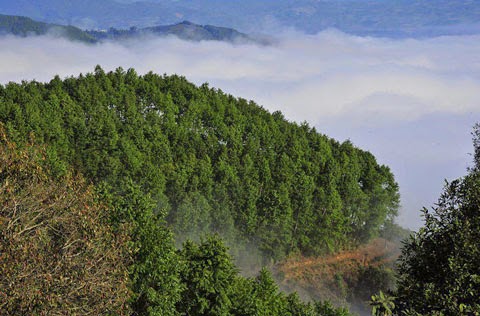
Jing Mai Shan- A Place A Pu Erh Tea Lover Shouldn't Miss

According to what we know, most of Pu Erh Tea lovers would wish to visit Yunnan province and have a look at the ancient tea trees. For most of foreign tea lovers, it seems rather difficult unless you follow a local tourist guide or join a tea tour. For most of the places in Yunnan province, it is not easy to access without the help of a local tourist guide while there is an exception. This place is called Jing Mai Shan (Jing Mai Shan Mountain or just Jing Mai, Shan literally mean mountain in Chinese). It has vast area of ancient tea gardens. If you love pu erh tea, you would not get bored even staying there for quite a few days. Going there during the tea harvesting season, you may also see tea plucking carried out by the local minority ethnics. If you are lucky, they may allow you to pluck the fresh tea leaves and learn the way of making tea.
Jing Mai Shan (Jing Mai Shan Mountain), one of the historical Six Tea Mountains, is located in Huiming Township, Lang Cang Luhu Minority Autonomous County, Yunnan Province. The history of growing tea there can date back to more than 2000 years ago. There are nine villages formed by local Bulang, Dai and Haini Minorities named Jingmai, Mangjing, Manghong and etc in Jing Mai Shan. At an elevation between 1100 and 1662 meters above sea level, the ancient tea gardens there total 16173 mu (1078 hectares), the biggest area among the historical Six Tea Mountains.
Several years ago, due to the road condition, the access to Jing Mai Shan was very tough. However, the road condition was dramatically improved during the recent years. Now, Jing Mai Shan is one of the places nearest to the airport. In Jing Mai Shan, hotel is not common yet. You may need to stay in Meng Hai County and then take a taxi to Jing Mai Shan. As far as what we know, Jing Mai Shan is one of such best place where whether tourists or professional tea businessmen can enjoy a pleasant tour.


More and larger photos of Jing Mai Shan can be found on our Facebook Page:
https://www.facebook.com/viconyteas or our Flicker photo album:
https://www.flickr.com/photos/127237463@N06/


Sunday, March 8, 2015

What Is Special About Man Zhuan Shan Pu Erh?

Man Zhuan Shan Mountain is one of the historical “Six Tea Mountains” – these are the original ones that are located north of Lancang River in Xishuangbanna, Yunnan province, China. This mountain and its five companions (You Le, Ge Deng, Yi Bang, Mang Zhi, and Man Sa) were key areas for growing tea since the mid-1700s. Now Man Zhuan Shan Mountain ministratively belongs to Manzhuan, Manlin two villages, Xiangming township, Mengla county, Yunnan province. The area has perfect natural environment for growing leaves necessary to make good pu-erh. (Over time as populations shifted and the market for Pu Erh teas changed, tea growing and production shifted to another six tea mountains south of Lancang River: Nannuo, Menghai, Bada, and Nanqiao near Menghai town, Jingmai in Hui Min County, and Mengsong.) Man Zhuan Mountain is beside Ye Xiang Mountain and the Mo Zhe River. At its peak, the mountain produced more than  500 metric tons of tea per year.

Now it is estimated that there is still about 2930 Mu (195 hectares) ancient tea gardens existing in Man Zhuan Shan Mountain. Ancient tea trees are mostly scattered among thick forests with different cultivars mixed  at an elevation between 565 and 1540 meters above sea level. Yunnan Large Leaf Camellia sinensis var assamica dominats here  while about 25% tea trees are categorized as small leaf cultivars which is called by locals as "Liu Ye Cha"(willow leaf tea).


Sunday, April 14, 2013

A pilgrimage to Yiwu(2)

After we had a lunch in Mr. Liang' home, we drove back to Mahei, passing Manxiu (曼秀) and Luo Shui Dong (落水洞) villages. We stopped over in Luo Shui Dong to see the legendary Tea Tree King said to be over 800-years old. Getting through a forest, we suddenly found half-way down the hill, a big tea tree in front of us. More than 10 meters in height, it isn't as spectacular as I imagined while if you want to harvest its leaves, it seems to be challenging and you may ask for the aid of a ladder.

In Mahei, with the help of Mr. Liang, we visited a few ancient tea gardens and enjoyed fresh Pu Erh teas in the homes of several local tea farmers.

We got to know that a large proportion of good quality Pu Erh was still produced from the Ancient Six Great Tea Mountains such as Yiwu(
易武), Yibang(倚邦), Youle(筱乐)in Xishuang Banna even now while high-yield terraced tea bushes have been grown in Yiwu on a large scale since 1980s. Tea bushes about 50cm in height were densely grown in parts of Yiwu. Compared to the traditional local tea trees, such tea bushes have a very high production and they can be harvested almost throughout a whole year. Although Pu Erh made of such terraced tea bushes differ much in quality with that of ancient arbor tea trees, it is still sold in the name of Yiwu Pu Erh at high prices and mostly, said to be of ancient arbor tea trees to meet the huge demand of the market. Such behavior severely ruined the reputation of Yiwu PuErh Tea. In fact, it is estimated that tea gardens of ancient arbor tea trees is no more than 30% of the total tea gardens in Yiwu now.

At an altitude of 1300 meters, Yiwu is a small town surrounded by mountains. During the prosperous time of Pu Erh tea trade, it was recorded that it had a population of more than 20000 while the corrupt Qing government and the competition of Indian tea directly caused the comedown of Yiwu town in late 19th. Century, plus pestilence that spread in this region and destruction inflicted by rebellious ethnic tribes, Yiwu became more and more desolate and less populated, by degrees finally passed into silence at the beginning of the 20th. Century. Now wooden houses are thinly scattered on both side of the only narrow street of Yiwu. With the resuscitation of Pu Erh Tea in recent 10 years, more and more people were attracted to the remote small town again. At night, it is quite and we soon fell into sleep in a small hotel in Yiwu.

In the next morning, enjoying the fresh air, we wandered on the old street of Yiwu town in a good mood. It is a street with a long history while it doesn't look antique. With many underway constructions, all was in a mess and dust was swirling in the air. As it hasn't rain for a long time, everything looked dull and grey.

The famous tea businesses such as Tong Xing Hao(
同兴号)Che Shun Hao(车顺号) and Fu Yuan Chan Hao(福元昌号)are said to have once been located around the place where Yiwu Primary School is now at. On right side of its playground once was an ancient temple while it has been replaced with the Ancient Six Great Tea Mountain Museum.

Crossed the playground was a bluestone road with old run-down houses on its both sides. Looked closely, the prints of the horses’ hooves left during the ancient time can still be made out in the bluestone road, reminding us it was the starting point of the famous Tea-Horse Ancient Route. More than 200 years ago, ancient Chinese people with simple and crude equipment travelled along the long and dangerous road on the risk of their lives to bring Pu Erh tea to Tibet, Mongolia or South East Asia. It is just so numerous ordinary people who made the brilliant history of Pu Erh Tea.


Luo Shui Dong Village: 


Tea Tree King at Luo Shui Dong:


Mahei Village:


Yiwu Old Street:


 The Ancient Six Great Tea Mountain Museum:


The Bluestone Road:


Over