Wednesday, March 11, 2015

Jing Mai Shan- A Place A Pu Erh Tea Lover Shouldn't Miss

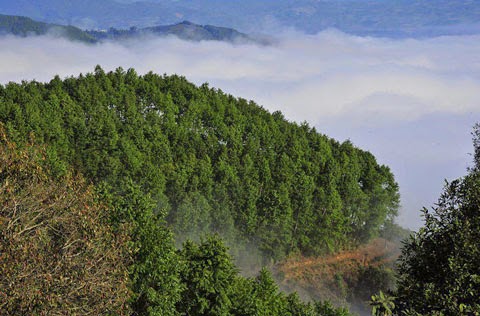
According to what we know, most of Pu Erh Tea lovers would wish to visit Yunnan province and have a look at the ancient tea trees. For most of foreign tea lovers, it seems rather difficult unless you follow a local tourist guide or join a tea tour. For most of the places in Yunnan province, it is not easy to access without the help of a local tourist guide while there is an exception. This place is called Jing Mai Shan (Jing Mai Shan Mountain or just Jing Mai, Shan literally mean mountain in Chinese). It has vast area of ancient tea gardens. If you love pu erh tea, you would not get bored even staying there for quite a few days. Going there during the tea harvesting season, you may also see tea plucking carried out by the local minority ethnics. If you are lucky, they may allow you to pluck the fresh tea leaves and learn the way of making tea.
Jing Mai Shan (Jing Mai Shan Mountain), one of the historical Six Tea Mountains, is located in Huiming Township, Lang Cang Luhu Minority Autonomous County, Yunnan Province. The history of growing tea there can date back to more than 2000 years ago. There are nine villages formed by local Bulang, Dai and Haini Minorities named Jingmai, Mangjing, Manghong and etc in Jing Mai Shan. At an elevation between 1100 and 1662 meters above sea level, the ancient tea gardens there total 16173 mu (1078 hectares), the biggest area among the historical Six Tea Mountains.
Several years ago, due to the road condition, the access to Jing Mai Shan was very tough. However, the road condition was dramatically improved during the recent years. Now, Jing Mai Shan is one of the places nearest to the airport. In Jing Mai Shan, hotel is not common yet. You may need to stay in Meng Hai County and then take a taxi to Jing Mai Shan. As far as what we know, Jing Mai Shan is one of such best place where whether tourists or professional tea businessmen can enjoy a pleasant tour.


More and larger photos of Jing Mai Shan can be found on our Facebook Page:
https://www.facebook.com/viconyteas or our Flicker photo album:
https://www.flickr.com/photos/127237463@N06/


Sunday, March 8, 2015

What Is Special About Man Zhuan Shan Pu Erh?

Man Zhuan Shan Mountain is one of the historical “Six Tea Mountains” – these are the original ones that are located north of Lancang River in Xishuangbanna, Yunnan province, China. This mountain and its five companions (You Le, Ge Deng, Yi Bang, Mang Zhi, and Man Sa) were key areas for growing tea since the mid-1700s. Now Man Zhuan Shan Mountain ministratively belongs to Manzhuan, Manlin two villages, Xiangming township, Mengla county, Yunnan province. The area has perfect natural environment for growing leaves necessary to make good pu-erh. (Over time as populations shifted and the market for Pu Erh teas changed, tea growing and production shifted to another six tea mountains south of Lancang River: Nannuo, Menghai, Bada, and Nanqiao near Menghai town, Jingmai in Hui Min County, and Mengsong.) Man Zhuan Mountain is beside Ye Xiang Mountain and the Mo Zhe River. At its peak, the mountain produced more than  500 metric tons of tea per year.

Now it is estimated that there is still about 2930 Mu (195 hectares) ancient tea gardens existing in Man Zhuan Shan Mountain. Ancient tea trees are mostly scattered among thick forests with different cultivars mixed  at an elevation between 565 and 1540 meters above sea level. Yunnan Large Leaf Camellia sinensis var assamica dominats here  while about 25% tea trees are categorized as small leaf cultivars which is called by locals as "Liu Ye Cha"(willow leaf tea).


Wednesday, November 19, 2014

Top Four Wuyi Yancha (Rock Oolong)- Have you ever tried them?

Wuyishan Mountain is an amazing Kingdom of tea trees. It produces countless tea cultivars. For hundreds of years, among them, some ones are considered  having supreme character.  Tea lovers usually call them "Ming Cong"(Famous Bushes名枞). Yancha made of Ming Cong  features rock charm and tastes mellow, thick, sweet and brisk, mixed with a flavor of wild tea. Its soup is orange yellow and bright. Mingcong tea tree requires an ideal environment, so most of them grow up in Mingyan producing area. There are four Ming Cong which are seen best and called "Si Da Ming Cong"(Top Four, 四大名枞). They are Da Hong Pao(大红袍), Tie Luo Han(铁罗汉), Bai Ji Guan(白鸡冠)and Shui Jin Gui(水金龟).


TOP 1 Da Hong Pao (Big Red Robe, 大红袍)


It is of course the most famous Wuyi Yancha (Wuyi Rock Oolong) but it is also most difficult to be found of satisfactory quality. In fact, most of Dahongpao you can find in the market are blended ones. Some made of in fact Shuixian or other tea cultivars can be very cheap. Purebred Dahongpao has only a small market share partly due to its small production. Blended Dahongpao has market share of more than 80%. In Chinese tea industry, which one is the genuine Dahongpao is still debated. Some consider it is Qidan while some think it is Beidou. Anyway, the two are of course the ones most suitable to be called as pure Dahongpao.

According to the legend, QiDan, the original name for Dahongpao, refers to tea from the six trees that look red from far away because of their purple-red gender shoots in early spring in Jiulongchao, Mount Wuyi.


Since 2007, Dahongpao tea trees in Mount Wuyi have been specially protected. It is forbidden to pluck their tea leaves to make sure they grow well; tea specialists look after them in a scientific way and detailed record of management is established; the nearby environment is strictly protected. Many years ago Chinese tea specialists started to cultivate Dahongpao trees by stem cutting propagation (asexual propagation). 


TOP 2 Tie Luo Han(Iron Warrior Monk 铁罗汉)


Tie Luo Han is one of the Top Four Wuyi Yancha,  and also believed to be the earliest Wu Yi tea; with history records dating back to Song Dynasty. The tea bush was first found in a cave (Gui Dong or Ghost Cave) in Hui Yuan Yan, one of the ninety-nine cliffs of Mount Wu Yi. Legend tells that this tea was created by a powerful warrior monk with golden-bronze skin, hence the name Tie Luo Han, which means "Iron Warrior Monk". It has been planted in many areas of Wuyishan Mountain now.

Tie Luo Han produced in core Zhengyan area is very limited in quantities every year and almost unavailable in markets. Tie Luo Han is pursued by Yancha fans because of its supreme quality. 


TOP 3 Bai Ji Guan (White Cockscomb 白鸡冠)


Bai Ji Guan, also called White Cockscomb in English, is a member of Si Da Ming Cong (the four famous Wuyi Oolong tea bushes). It is also regarded as one of the most famous Chinese oolong teas. Legend goes that one day a monk saw a rooster sacrifice its life while protecting its child from an eagle. He was moved by the rooster’s courage and then buried its dead body in the ground. However, after a few days, a tea bush grew from the spot where the rooster was buried. In the memory of the rooster, the monk gave the name of White Cockscomb to the tea bush.

Bai Ji Guan is undoubtedly one of the most unique Wuyi Yancha. You can easily tell it apart not only by its appearance but also its taste and flavor.  The fresh leaves of the Bai Ji Guan Rock Oolong are yellowish dark. The brewed tea has a bright pale yellow color. It is sweet and uniquely fruity with a lingering mellow fruit and honey note aftertaste, much more delicate than other kinds of Wuyi Yancha in taste.


TOP 4 Shui Jin Gui (Water Golden Turtle 水金龟)


One of Wuyi top four teas, Shui Jin Gui, which means "Golden Turtle" is strong and rich tea with a very slight hint of fruity aroma. According to Chinese legends, Shui Jin Gui tea plant is a transmigration of a turtle god. Despite achieving godhood after a thousand years of meditation, the turtle god soon felt discontented as his hard effort as the Heaven's Tea Gardener often went unnoticed. One morning, he awoke to the noise of tea farmers celebrating their harvest of first flush tea leaves happily. Upon seeing this, the turtle god realised that he would be better appreciated as a tea plant and thus he gave up his immortality to become the Shui Jin Gui tea plant.

Shui Jin Gui is known for its soft texture and unusually gentle nature. The cup is peachy red with notes of chocolate and toasted nuts. There is also a pleasant reminder of its flowery note, lingering after each sip.


You would be probably interested in:

Wuyi Rock Oolong Tea | Wuyi Yancha FAQ: 
Photo Gallery of Wuyi Rock Oolong Core Producing Areas

Sunday, September 21, 2014

White Tea and the legend of Taolaoshan Mountain

Tailaoshan Mountain located in Fuding, Fujian province is a place famous for its scenery or historical relics. An ancient Chinese legend told during the time of Xuanyuan and Huangdi Emperors' reign, a celestial being of Taoists named as Rong Chengzi used to inhabit here and during the time of Yao Emperor‘s reign , there was a young girl who spent all day growing orchid and tea trees here and  teach local people how to make "White Tea". The White Tea she made was so delicious, fragrant and amazing that people who drank it all the time finally became celestial beings. The young girl lived so long time, becoming to be mother, grandmother and grand-grand-mother, before she grew out wings and became to be a goddess. The local people respected her very much and called her "Taimu"(meaning grand-grand-mother) and called the mountain she lived as "Taimushan Mountain". According to the record of  "Pan Tao Ji", a book written by Wang Lie in Han Dynasty, Emperor Han Wudi once ordered Dong Fangsuo, a his confidential secretary to visit all the famous mountain in the world. Dong Fangsuo thought among all the famous mountains he visited, Taimushan Mountain is rich in distinctive nimbus and beauty so he called it "the First Mountain of the World" and replace "Mu"(meaning mother) with "Lao"(meaning grandmother) to show respect for the past person. It is common that "famous mountain produce famous teas". Tailaoshan Mountain is the same. The Fuding area of Fujian Province where Tailaoshan Mountain is located is well known as "the hometown of Chinese White Tea" now. WhiteTea was initially brought into being here and now still mainly produced in Fuding area.
In 1796(the first year of the reign of Qing Emperor Jiangqing, the tea businessmen of Fuding realized the potential business opportunity of White Tea so they learned the skills of making white tea from the people of Tailaoshan Mountain and succeeded in making "native needle" with the local tea cultivar called "Caicha". It was seen by Chinese tea industry as the sign of the birth of modern White Tea. In 1857(the 6th year of the reign of Qing Emperor Xianfeng), a dutiful son thought to be given direction from Tailao (The Goddess of the Tailaoshan Mountain) found a tea seedling neighboring to an ancient tea tree called Lu Yueya(literally Green Snow Bud) around the Hongxue cave of Tailaoshan Mountain and he uprooted and replanted the tea seedling in the area outside Tailaoshan Mountain. Tea makers of Fuding successfully  made Baihao Silver Needle White tea with buds harvested from the tea trees cultivated from the tea seedling. Now, the Lu Xueya tea seedling seen as a fine breed and named as "Fuding Dabaicha Cultivar" has been now propagated by stem cuttings in more than 10 provinces of China since 1960s.
The Scenery of Tailaoshan Mountain

The Scenery of Tailaoshan Mountain

The Scenery of Tailaoshan Mountain

The Goddess of Tailaoshan Mountain

The Scenery of Tailaoshan Mountain

The Scenery of Tailaoshan Mountain


Sunday, September 14, 2014

Guangdong Morning Tea

Drinking fine tea over delicious snacks is a supreme treat for Guangdong people. They like to do in teahouses during the morning.  Locally known as "one cup of tea and two snacks," the morning tea is regarded by the Guangdong people as "a joy of life."


Teahouses in Guangdong serve various kinds of teas and famous Guangdong-style snacks. The tea includes black tea, green tea, Oolong tea, jasmine tea and Liubao tea. The snacks include steamed buns stuffed with diced grilled pork, diced pig fat and sugar, minced pork, shrimp or crab meat, steamed dumplings with the dough gathered at the top with various fillings; and all kinds of flaky cakes. Before going to work in the morning, drinking a fragrant pot of tea and relishing the delicious snacks in a teahouse, proves a most relaxing experience. In recent years, with business burgeoning in Guangdong Province, people like holding business talks in teahouses. In Hainan Province, the practice has reached the extent that you can not enter the business circles without frequenting a teahouse. Drinking tea for business purposes has become a peculiar way of life in Guangdong and Hainan provinces, although it is far removed from the Chinese traditional purpose of tasting tea.


Unlike those in Jiangsu and Zhejiang provinces, and in northern provinces, Guangdong teahouses provide breakfast for customers. Called "morning tea" by Guangdong people, it evinces the importance of tea at breakfast. Today Guangdong-style morning tea has gone beyond Guangdong and Hainan provinces and found its way into large hotels in Beijing, Tianjin and Shanghai, although patrons do not number as high as those in Guangdong.

Sunday, August 31, 2014

Tea-Drinking Customs In Fujian And Guangdong Of China

"Gongfu" Tea In Fujian And Guangdong Provinces Of China

China is the home of tea, and drinking tea is a national obsession.  Chinese are the most likely to delight in drinking tea as well as being the most discriminating in the way tea is made and served.

Tea-drinking tradition from the Ming and Qing dynasties, which features infused tea, has been inherited in most parts of China. But people from different areas favor different teas. Generally, people in northern China, northeastern China and Sichuan Province, love jasmine tea; those living in Jiangsu, Zhejiang and Anhui provinces favor green tea; and along the southeast coast, Oolong tea is preferred. People from Hunan Province have an interesting habit: they chew and swallow the tea leaves after drinking the infusion.


Distinct customs in different areas and minorities compose the variety of China's tea-drinking tradition.


Preparing and drinking "Gongfu" tea involves elaborate procedures. This tea is popular in Yunxiao, Zhangzhou, Dongshan and Xiamen in southern Fujian Province, and Chaozhou and Shantou in Guangdong Province.


The antique-looking "Gongfu"tea set includes "Four Treasures for Tea-Making": one is a reddish-brown kettle, "yushuwei," with an oblate body that holds only 200g of water; the second is "Shantou Wind Stove," which is a small, exquisite and vented stove, used to boil water. Today, for convenience, many people use the electric stove. The third is a teapot, "Mengchen Pot," the size of a goose egg, made of zisha, a fine clay from Yixing that holds just over 50g of water. The last is "Ruochen'ou," an extraordinarily small cup about the size of half a pingpong ball, which holds only 4ml of the brew. Usually, four cups make a set and are placed on an oval tea tray. Besides pottery tea sets, there are porcelain ones, which look distinct with blue floral patterns glazed on a white background.


With "Four Treasures", you can make tea. In preparing "Gongfu" tea, you must undertake a unique process. First, rinse the tea set in clean spring water and place it on a tea tray. When the water in the kettle is boiling, use some to warm the pot and cups. Then put tea leaves in the tea pot until it is half-full and add boiling water until it reaches the brim. Purists will immediately pour out the first infusion and warm the tea cups with it. Again, fill the pot with boiled water, using the lid to skim off the foam before covering the pot to preserve the aroma. Arrange the four cups in a square, their mouths all touching. Wait a moment (less than one minute) before lifting the pot and moving it in circles over the cups while pouring tea until each cup is filled. Known locally as "General Guan Patrollinging the Town," this ensures that the density of tea is the same in each cup. Even the final and most dense bit is poured evenly into the four cups-- known as "General Han Xin Dispatching Troops."


Once the tea has been poured in the tea cups, that does not mean you can drink it immediately. According to the practice of "Gongfu" tea, you should first lift the cup to your nose and inhale the fragrance. Then take a sip, and hold it in your mouth to taste its flavor; in no time you will feel your nose and mouth filling with the fragrance, your throat moistening, and the secretion of saliva increasing, which will comfort your whole body. Add more water to the pot and enjoy another round of tea. After, at most, the fifth round, replace the tea dregs with new tea and start over.


The best tea for "Gongfu" tea is Oolong -- for green tea has a "cold nature" that pains the stomach and black tea has a "hot nature" that seems to dry the stomach; neither is suitable to be drunk undiluted. Only the half-fermented Oolong, having a "warm nature" and enduring infusion, is best for "Gongfu" tea.

Thursday, July 17, 2014

10 Famous Tea Paintings

Tea has been popular during Victorian age, so the tea cups or pots were also frequently part of the paintings depicting the everyday life. The Impressionists often included tea in their visual stories, which shows the increasing popularity of the beverage. The contemporary art also has a taste for tea, as you will certainly discover in our top 10 famous tea paintings.

 # 1 Five O’Clock Tea by Julius LeBlanc Stewart


Julius LeBlanc Stewart (1855 – 1919) was an American artist from Philadelphia who spent his career in Paris. He exhibited regularly at the Paris Salon from 1878 into the early 20th century, and helped organize the Americans in Paris section of the 1894 Salon.

This painting is suggestively named “Five O’Clock Tea”, depicting an afternoon tea meal which was highly popular during the painter’s time. “Five O’Clock Tea” was finished in 1884 and presently can be admired in a private collection of Iris and Gerald Cantor, New York.


# 2 Tea in the Park by Edward Cucuel


Edward Alfred Cucuel (1875-1954) was born in San Francisco, California. He is best known for his paintings of sunny genre scenes of boating, afternoon tea, sleeping or reading in landscape settings. According to Fritz von Ostini, in his book “Der Maler Edward Cucuel” the artist never employed professional models, preferring instead to represent his friends and family.

This is an impressionist painting depicting what was really fashionable back in the days of Edward Cucuel, long walks in the park, the joy of admiring the nature and the afternoon tea custom  highly enjoyed by society elites.

# 3 Tea by George Dunlop Leslie


George Dunlop Leslie (1835 – 1921) was an English genre painter, author and illustrator. His early works, showed the strong influence of the Pre-Raphaelites, but he settled into a more academic, aesthetic, style of painting with the aim of showing pictures from the sunny side of English domestic life. Leslie was also an author and had several books published.

“Tea” was painted in 1885. It depicts a very young woman in the dress of the 1700s, standing behind a table covered with a white cloth. She is about to serve tea from a blue willow tea set. Cups with spoons, cream jug, and sugar bowl with lump sugar are all ready on a tray. Behind her is a wooden chair and a white paneled wall.

# 4 Lady at the Tea Table by Mary Stevenson Cassatt

 
Mary Stevenson Cassatt (1844 – 1926) was an American painter and printmaker. She lived much of her adult life in France, where she first became friends with Edgar Degas and later she exhibited her work among the Impressionists. Cassatt often created images of the social and private lives of women, with particular emphasis on the intimate and affectionate bonds between mothers and children.

This painting was a gift from the painter to the Metropolitan Museum of Art, New York. She donated the painting in 1923.

# 5 Tea Time by Georges Croegaert


Georges Croegaert (1848-1923) was a Belgian academic painter. Though he was born in Antwerp, Belgium, he spent most of his life in Paris. His name is associated with both classicism and anti-clerical art.

The painting is depicting a cardinal of the Roman Catholic Church enjoying a cup of tea. The body position of the priest and the luxury which surrounds the cleric makes this picture a silent critic brought to the higher representatives of the Catholic Church and the luxury they indulged in.

# 6 The Tea Party by Frederic Soulacroix


Frederic Soulacroix (1858-1933) was an Italian academic painter. He was an artist who enjoyed an enormous success during his life. His paintings were mainly for private customers coming from USA, England, Germany (Munich especially), South America, and Canada. He is also famous for making a portrait of Queen Margherita, wife of King Umberto I of Italy and those of the King of Siam and his brother, Prince Sanbasaska.

This is a painting found in a private collection depicting a social scene very popular in those days, tea parties. The ladies wear evening dresses very fashionable at the end of the 19th century.

# 7 Washing Dishes – Emily and her Tea by Charles Courtney Curran


Charles Courtney Curran (1861 – 1942) was an American painter. He is famous for his canvases depicting beautiful women in beautiful settings.

The picture depicts a sweet small girl around seven years old washing a tea set. It is an amazing picture of domestic life during Curran’s time.

# 8 At the Tea Table by Konstantin Korovin


Konstantin Korovin (1861-1939) was a leading Russian Impressionist painter and a talented stage designer. In 1885, Saava Mamontov hired Korovin to design the set for his private opera. By 1900, Korovin had become the designer for the Imperial Theater in Moscow, which is known as the Bolshoi Theater.

This is a painting dating from 1888 depicting a domestic family scene of an afternoon meal and as you can observe the teapot occupies the center of the table suggesting that it was an important piece of kitchenware and that tea was a fashionable beverage.

# 9 Lovely Vase and Cup of Tea by Jamie Paterno


Jamie Paterno is a contemporary Argentinean artist known for the use of vibrant colors delicately spread across canvases in figurative works and still life. The artist graduated from the Fine Art College at Seoul Women’s University and is currently affiliated with several art associations. She has exhibited extensively in both South Korea and the United States since 1995.

This is a painting which places a nice cup of tea near a lovely vase as the painter herself names it, featuring vibrant colors and a childish touch remanding of fairy tales which have long inspired the artist since her early childhood.

# 10 Afternoon Tea by Richard Emile Miller


Richard E. Miller (1875 – 1943) was a major American Impressionist painter and a member of the famous Giverny Colony of American Impressionists. He was mainly a figurative painter, known for his paintings of women posing languidly in interiors or outdoor settings. He is best described as a Decorative Impressionist.

The painting was finished in 1910 and it depicts women in a sunlit landscape framed by a large, vividly patterned Japanese parasol, which exemplifies Miller’s decorative technique.

We are really curious which one of these amazing paintings has enchanted your eyes and heart. If you know other paintings where tea is depicted, feel free to share them here.